
Saturday, 9 March 2013
New Home
For technical reasons I have decided to move my blog over to wordpress please go to our new home at http://fumbel.wordpress.com/

Friday, 4 May 2012
Interview with Monte Cook!!!!!

Firstly thank you for making a geek's dream come true. I truly appreciate you taking the time to talk with us, especially with your busy schedule.
 Thanks for asking!
 Could you please tell us about yourself: age, hobbies outside gaming, so on?
I'm 44. I live in Seattle. Besides gaming, I really enjoy writing fiction, reading, travel, music, and movies. I also am really into Legos! So, I'm a big geek.
How did you initially get into playing RPGs?
I heard about roleplaying games when I was about ten years old, in Sunday school of all places. Two brothers were talking about a map on graph paper, traps, monsters, and a magical crown. I had no idea what they were talking about, but I knew I wanted in.
What was the first gaming system you played in? Can you remember anything about your First Character?
D&D (the original, small booklets from 1974) was the first game I played. It wasn't until a year or two later that I actually owned any rpg products, the first being the just-released AD&D DMG. My first character was a fighter, and I don't remember much about him. Later, though, I remember having a
ranger named Thad the Brave.
Do you get to play in a campaign, how often do you play? When you do, what system do you normally play?
Until just a couple of weeks ago, I was in a playtest for the new, upcoming edition of D&D. Before that, I was running a variation on 3rd edition with a lot of house rules (most of which appear in the books The Book of Experimental Might I and II) for a few years.
What is your favourite character you have played, could you tell us something about them?
 That would probably be Malhavoc, a D&D wizard/cleric that I played long, long ago. He was an evil character that redeemed himself in the end.
Mostly, though, I don't play much. I run games instead. I'd say I'm the GM about 98% of the time when I play an rpg.
Do you have any funny gaming moments?
Sure. Thousands. I think everyone does. One time, a paladin vain about his appearance was on a quest to bring a villain named Helmut Itlestein to justice. He followed him into this otherworldly realm where an evil demigod lived. The demigod told the paladin that the man was dead. The paladin demanded proof to take back with him. So the demigod burned the words "Helmut Itlestein is dead" onto the paladin's beautiful face.
I can be a mean DM.
Do you have any gaming superstitions?
Not really. I'm not touchy or particular about dice or sheets or anything.

Considering all of the items you’ve published throughout the years, what is the one thing you’re most proud of?
That's really hard. I suppose it might be the campaign setting, Ptolus, just because it came out so wonderfully. It's beautiful, it's a feat of game design and editing (it takes a lot of broad steps forward in how a product can be presented), and I'm still quite in love with the content.
That said, D&D 3rd Edition made hundreds of thousands of people really happy for a lot of years, so I'm proud of that too.
What's a typical day in the life of Monte in terms of preparing your own role playing campaign
I usually make a lot of chicken scratch notes that would make sense to no one but me. For NPCs, I'll often just prepare the most important stats, or just take something out of a published source and change what I need to (sometimes on the fly). Basically, I often prepare the big stuff, and sometimes the cool descriptions of things (I'm a very visual person), and then pull together the details on the fly.
I try to make that kind of "on the fly" GMing as easy as possible, though, so I keep things like lists of cool names, books with cool art, and products with stat blocks, cool spells, monsters, and whatnot close at hand.
What's the secret to being a good GM outside of following the official materials?
The number one key is making sure everyone's having fun. Sounds oversimplified, but if you do that, you'll run a good game. Fun trumps rules, story, and anything else. And remember, "everyone" includes you, too.
What do you think of the changes the way the RPG industry is currently changing, and heading towards more digital products?
I think we going to see interesting melding of tabletop and digital over the next few years. But tabletop will always have value for its social components.
What’s next for you?
I also am writing a lot of fiction. You'll see some of my short fiction popping up in various places this year.
Do you have any other parting words for all of the gamers out there?
Worry less about what other people are doing in their games, and focus more on having fun in your own. Edition wars are so tired, and have done terrible damage to the game and the audience. If you love your Honda, but someone else drives a Ford, it doesn't affect how you drive. It's a game no one is going to win, no matter how pithy your criticism of someone else's system might be. We're all gamers, and we all love games.
I also am writing a lot of fiction. You'll see some of my short fiction popping up in various places this year.
Do you have any other parting words for all of the gamers out there?
Worry less about what other people are doing in their games, and focus more on having fun in your own. Edition wars are so tired, and have done terrible damage to the game and the audience. If you love your Honda, but someone else drives a Ford, it doesn't affect how you drive. It's a game no one is going to win, no matter how pithy your criticism of someone else's system might be. We're all gamers, and we all love games.
Wednesday, 2 May 2012
Fumbl Tv intro video finally started
Its been a while but I have finally gotten a start on the videos again and also have a co host more to come soon please leave any comments on the intro.
Wednesday, 15 February 2012
Interview with the Chatty DM from Critical Hits

First off, let me thank you for taking the time to be interviewed for Fumbl. I truly appreciate you taking the time to talk with us, especially with your busy schedule. And Congratulations on your second
year at Critical Hits!
Could you please tell us about yourself: what you do, age, hobbies
Outside gaming, so on?I'm a 39 y.o. French Canadian Montrealer I'm a self-employed consultant in the field of Pharmaceutical and Healthcare Quality Assurance. I'm a voracious reader (Fantasy, Sci-Fi, Young Adult and graphic novels of all kinds). I love movies, biking and eating in good restaurants.
 How did you initially get into playing RPGs?
One day when I was 9 or 10, a friend showed me this game he had played at his cousins over the weekend. He then made up a game based on his experience. He'd took 2 sheets of paper, gave one to me and a d6. He told me: Write the name of your adventurer on that paper and write "Sword" and "Shield". He drew a corridor on the second sheet, then a room and drew a monster in it (he was quite the artist) and said: Okay, there's a monster here, he says you can't pass, what do you do? And thus I started playing RPGs. For the record, our rules were awesome: Whenever we fought a monster, we rolled the d6. On a 1 the character died on a 6, the monster died. We roleplayed all results in between.
What was the first gaming system you played in? Can you remember anything about your First Character?
Oh yes, we were playing a bastardized version of AD&D 1e (didn't we all?) and I was playing a Gnome Illusionist! Because illusionist spells rocked in my mind. I eventually changed my mind. :)
Do you get to play in a campaign, how often do you play? When you do,what system do you normally play?
I have not played in a campaign for a long time. I've been a GM for more than 95% of my games of the last 3 decades. The last 3 campaings I played were D&D 3.5, Star Wars Saga Edition and d20 WoD/Modern
What is your favourite character you have played, could you tell us something about them?
My absolute favourite characters I've played were, predictably, NPCs. One was a Halfling priest of the god of food. He was huge, always happy and used a half-eaten turkey leg for a holy symbol. Getting healed by him always left you with grease stains on your tunic.
Do you have any funny gaming moments?
A ton, after 30 years you collect them. One of my fondest memories was this story.

Do you have any gaming superstitions?
Not much... I do kinda like to believe that dice can "run out of juice" but I don't have a lot of gaming superstitions. I do like to arrange my dice by size though. But that's not crazy right?
Considering all of the items you’ve published throughout the years, what is the one thing you’re most proud of?
That's a trick questions for me since I barely started. I'd say two of them: My "When Madness Seeps Through" adventur
e that I wrote for the Goodman Games anthology "From Here to There". That was my first official gaming publication and I managed to complete it while in in the grip of a severe depression. I channeled my energies to completing the project and it probably helped me recover. The second one was my 1st Dungeon/Dragon magazine articles about level 0 characters for D&D 4e. I'm happy that WotC let me express my crazy ideas for the rules I made and the adventure I wanted to write. They left me a lot of creative liberty and I'm extremely grateful for that.
What's a typical day in the life of a Chatty DM in terms of preparing your own role playing campaign?
In the last two years I've moved campaign preparation to the gaming table. I will make "world making" sessions with the players by asking them questions and using their answers to generate allies, ennemies, places and situations. I then build the first scenes of the campaign with these elements and build the campaign from there. It saves me a BUNCH of time and the scenes are always engaging to the players
What's the secret to being a good GM outside of following the official DMG's?
The one secret I can share is this: You aren't as bad as you think you are, you aren't as good as you think you are. People show up week after week to play with YOU as the GM, it means a lot. Empower yourself with that. Yet, don't become complacent and overconfident of your GMing style. Always be ready to become a better GM by listening to and observing your players. Read GMing blogs and forums. Talk to others and try to make the next session a little bit more awesome by trying something you've never tried. Try making funny voices, try a non-linear game, ask your players to create the next scene... go wild. The GMing experience is limitless in it's application, spend your life perfecting this noble art.
What do you think of the changes the way the RPG industry is currently
changing, and heading towards more digital products?
I've started running whole session with nothing but index cards, pencils, dice and my iPad. I'm ALL for RPGs making it to the digital age. Books are absolutely great for references (Adventure design)
 What’s next for you?
I've been hired to be the Development Assistant for the next Marvel RPG event book: Civil War. I can't wait to tackle that one.
year at Critical Hits!
Could you please tell us about yourself: what you do, age, hobbies
Outside gaming, so on?I'm a 39 y.o. French Canadian Montrealer I'm a self-employed consultant in the field of Pharmaceutical and Healthcare Quality Assurance. I'm a voracious reader (Fantasy, Sci-Fi, Young Adult and graphic novels of all kinds). I love movies, biking and eating in good restaurants.
How did you initially get into playing RPGs?One day when I was 9 or 10, a friend showed me this game he had played at his cousins over the weekend. He then made up a game based on his experience. He'd took 2 sheets of paper, gave one to me and a d6. He told me: Write the name of your adventurer on that paper and write "Sword" and "Shield". He drew a corridor on the second sheet, then a room and drew a monster in it (he was quite the artist) and said: Okay, there's a monster here, he says you can't pass, what do you do? And thus I started playing RPGs. For the record, our rules were awesome: Whenever we fought a monster, we rolled the d6. On a 1 the character died on a 6, the monster died. We roleplayed all results in between.
What was the first gaming system you played in? Can you remember anything about your First Character?
Oh yes, we were playing a bastardized version of AD&D 1e (didn't we all?) and I was playing a Gnome Illusionist! Because illusionist spells rocked in my mind. I eventually changed my mind. :)
Do you get to play in a campaign, how often do you play? When you do,what system do you normally play?
I have not played in a campaign for a long time. I've been a GM for more than 95% of my games of the last 3 decades. The last 3 campaings I played were D&D 3.5, Star Wars Saga Edition and d20 WoD/Modern
What is your favourite character you have played, could you tell us something about them?
My absolute favourite characters I've played were, predictably, NPCs. One was a Halfling priest of the god of food. He was huge, always happy and used a half-eaten turkey leg for a holy symbol. Getting healed by him always left you with grease stains on your tunic.
Do you have any funny gaming moments?
A ton, after 30 years you collect them. One of my fondest memories was this story.

AD&D's Queen of the Demonweb Pits, the characters enter a room with this huge mirror in the back that just happens to be a very powerful magnet. As the cleric in full late enters, he gets pulled into the room and crashes into the magnet while dozens of gnolls come out from each side of it. The party's Magic User, seeing so many Gnolls filling the room retreats and casts "Wall of Iron". When he said that, I paused for a few seconds, looked at the Magic user, and said: "As the wall materializes in the room, cutting off the gnolls from reaching you, you notice it start wobbling. Before you can do anything, the wall flies through the room, knocks down several gnolls and CRUSHES the poor cleric stuck on the MAGNET! I still laugh when I think about that story... I was 15.
Do you have any gaming superstitions?
Not much... I do kinda like to believe that dice can "run out of juice" but I don't have a lot of gaming superstitions. I do like to arrange my dice by size though. But that's not crazy right?
Considering all of the items you’ve published throughout the years, what is the one thing you’re most proud of?
That's a trick questions for me since I barely started. I'd say two of them: My "When Madness Seeps Through" adventur
e that I wrote for the Goodman Games anthology "From Here to There". That was my first official gaming publication and I managed to complete it while in in the grip of a severe depression. I channeled my energies to completing the project and it probably helped me recover. The second one was my 1st Dungeon/Dragon magazine articles about level 0 characters for D&D 4e. I'm happy that WotC let me express my crazy ideas for the rules I made and the adventure I wanted to write. They left me a lot of creative liberty and I'm extremely grateful for that.
What's a typical day in the life of a Chatty DM in terms of preparing your own role playing campaign?
In the last two years I've moved campaign preparation to the gaming table. I will make "world making" sessions with the players by asking them questions and using their answers to generate allies, ennemies, places and situations. I then build the first scenes of the campaign with these elements and build the campaign from there. It saves me a BUNCH of time and the scenes are always engaging to the players
What's the secret to being a good GM outside of following the official DMG's?
The one secret I can share is this: You aren't as bad as you think you are, you aren't as good as you think you are. People show up week after week to play with YOU as the GM, it means a lot. Empower yourself with that. Yet, don't become complacent and overconfident of your GMing style. Always be ready to become a better GM by listening to and observing your players. Read GMing blogs and forums. Talk to others and try to make the next session a little bit more awesome by trying something you've never tried. Try making funny voices, try a non-linear game, ask your players to create the next scene... go wild. The GMing experience is limitless in it's application, spend your life perfecting this noble art.
What do you think of the changes the way the RPG industry is currently
changing, and heading towards more digital products?
I've started running whole session with nothing but index cards, pencils, dice and my iPad. I'm ALL for RPGs making it to the digital age. Books are absolutely great for references (Adventure design)
 What’s next for you?
 I've been hired to be the Development Assistant for the next Marvel RPG event book: Civil War. I can't wait to tackle that one.
Thursday, 19 January 2012
Interview with Filamena Young
 First off, let me thank you for taking the time to be interviewed for Fumbl. I truly appreciate you taking the time to talk with us, especially with your busy schedule.
No problem at all. Without dialogue and contact to the outside world, game designers can turn into very grumpy cave dwellers very quickly.
Could you please tell us about yourself: age, hobbies outside gaming, so on?
Age? Ouch. Well, I’m just over 30. Steven King says you can’t accomplish anything serious as a writer before that, so I’ll take it as a good thing. My hobbies include chasing my two kids around, erm, between that and writing, I have no time for much of anything else. I like the occasional video games. Minecraft and the Sims. That sort of thing.
Who have you worked for, what games have you worked on?
So I worked on supplements for Vampire, Werewolf, Hunter and Mage for the New World of Darkness Line for White Wolf. I did a little bit of work on Blood in Feraldyn for Green Ronin. I worked on the High School Yearbook for Margret Weis’s Smallville, and a lot of small stuff here and there, plus the three games my company has put out in the last few years.

How did you initially get into playing RPGs?
About a hundred years ago, when I was young, my parents got me an NES and the first Final Fantasy game. I was hooked, my friend and I spent hours playing it to completion with a Nintendo Power as our guide. Later, my dad gave me a friends old (incomplete) box set of AD&D. It didn’t have all the dice. That didn’t stop me. I GMed for some friends and it was love at first roll. Soon after, I was in highschool playing games probably more than I spent doing school work. (Whoops. Don’t do that, kids in school.)
What was the first gaming system you played in? Can you remember
anything about your First Character?
As a player, I started with AD&D. I played a pacifistic priestess of a fertility goddess. You can imagine, AD&D was not kind to the roleplaying leaning-type, but my group loved it, and we adapted things to fit that style quickly. It got very political and social very quickly.
Do you get to play in a campaign, how often do you play? When you do, what system do you normally play?
I haven’t played a real campaign since the Carter Administration. The closest I get are some longer running World of Darkness chat-style games. It’s a very strange animal and I don’t have much time for even that these days. There’s just too many games to try and too many games I want to make. I miss the five-year long games of my youth, but I know I couldn’t go back even if I wanted to.
What is your favourite character you have played, could you tell us something about them?
 It would probably be easier for me to tell you which was my favorite child. When I first met my husband, I had a Requiem character. She was a horror writer, and didn’t have much patience for the sillier sort of vampire she met. It could get snarky, but ultimately, she ended her story heading off to seek vampire-nirvana. A lot of fun.
Do you have any funny gaming moments? At least a year or two back, we played a semi regular Hunter game. My husband was running it, and all the players were ladies. We did a lot of clever things to handle monsters from a distance, none of us were front-line sort of killers. Ultimately, we decided that there was almost no monster that couldn’t be handled most easily than by hitting them with a truck. The mental hoops we jumped through to get all manner of evil monster into situations where we could hit them with a truck were hilarious. I highly recommend it to any monster-slayer out there. It’s my weapon of choice now.
Do you have any gaming superstitions? (personally I wont use a Dice in a game until its rolled 1000 times!)
I don’t think so. I do pay attention to a sort of, mmm… Feng Shui at the gaming table. Sometimes if players are sitting in the wrong place, you know, it’s just not going to flow as well. But that might be practical too. Put the mousey, quieter players nearer to the GM, the loud attention cravers further. That sort of thing.

How did you get started with Flatpack? Where did your inspiration come from?
I wanted a game I’d feel happy about my daughters playing when they’re old enough. I also looked at the sorts of things I wanted to do in a game, and rather than wait for someone else to do it, I did it myself.
Why should we play it? Does it bring anything new to our gaming?
I wanted to focus on non-violent conflict resolution, community building, and borrow back aspects from video games I thought were cool. My character advancement system, for example, is drawn from video game Achievements. You do X, your character is now a little bit better at Y. People seem to be really digging that.
Considering all of the items you’ve published throughout the years, what is the one thing you’re most proud of?
Aww, that’s not fair. I really really enjoyed writing fiction for Amaranthine, our second game, but there’s something about doing all of the development and writing for Flatpack that’s very exciting.
What's a typical day in the life of Filamena in terms of preparing her own role playing campaign?
Prepare? I’ve heard of it. I don’t know that I’ve ever actually done it. I’ll sometimes write down some clues or plot hooks and NPC notes on index cards, but by and large, I’m a by-the-seat-of-my-skirt sort.
What's the secret to being a good writer?
Sit down and do it. You can always fix it later. Talking about the processes, reading about it, that’s all cool, but a lot of people let that get in the way. Theory is only good if you apply it to practice. I’d rather be polished through practice than study. JD Salinger types only confuse me.
What do you think of the changes the way the RPG industry is currently changing, and heading towards more digital products?
Yay! More games is better than fewer. More games that break the same molds over and over. That’s the way to go.
What kind of new goodies are coming out from Machine Age Productions?
Aside from the million books I’ll be doing for Flatpack to go along with the Kickstarter, (three, at this point) We’re doing series three of Guestbook pretty much as we speak. Next up, and hopefully for Gencon of this year, David’s designing what he calls a ‘progressive post-fantasy’ game. I’m not sure how he’s going to unpack that statement yet, but he came up with calling Flatpack an ‘Optimistic Apocalyptic’ game, so I’m ready for the fun. I believe the scientific method will be a big part of the system. Also, archeology. Really. It’s gonna be cool.
What’s next for you?
Rumor has it I’ll be working on something that Margret Weis is rolling out now. (Its okay to be a little jealous.) I’m also likely going to be doing a game hack for Evil Hat’s Don’t Rest Your Head book of hacks. After that, it’ll be rushing to complete stuff for Gencon, and having a third kid in May. (Woo!) So basically, I have to type in my sleep to get it all done. But it’ll be worth it.
Do you have any other parting words for all of the gamers out there?
Yeah. We can make gaming better, safer, and bigger with room for all sorts of games and players. We can be welcoming and increase our numbers and make sure the industry thrives. There’s room for everyone, if we just make room.
Monday, 16 January 2012
More to come!
Ok so everybody knows I have not gone away. In fact I have been busier than ever. Its been a hectic Holiday period but I have some great content coming up. we have the long awaited interview with Jess Hartley of White Wolf fame. Another with Filamena young the Creator of Flatpack (more on this soon) another with the grande master of D&D Monte Cook! and thats not all. I will also be conducting a video interview with Kevin Siembieda and will also be starting the video cast Fumbl TV! If anyone wants me to cover anything specific or if there's any companies out there that want me to post their latest news please let me know.
Wednesday, 14 December 2011
Brief Interview With Artist Gavin Hargest

Gavin Hargest, or better known as Gav likes to illustrate the dark side and macabre, the strange and the unusual… He can be found lurking the valleys of South Wales situated in the UK which some say he calls home.. Surprisingly his favorite colour is blue.
Gav I've
been professionally illustrating as a freelance artist for almost 3
years now, not long in
the industry filled with godly talent, but I enjoy it, it's something
different and stops me doodling on anything flat I can find . . . .
In my old day jobs that's all I would do lol.
Adam Have you had any formal
training in the fine arts?*
Gav I have a degree in
Illustration, a BA(Hons), although back in my Uni days I wanted to become a
children's book illustrator, working solely in bright colours with
pencils . . . . How things change, the moment I left Uni my style of art
evolved, or perhaps a better word would be decayed into a dark and
gritty representation of modern urban horrors, or just darker styled.
(I like how that long sentence sounds)
Adam What are your biggest
artistic influences and inspirations?
Gav I'm going to have to say
I have 2 main influences, firstly the art direction behind the
White Wolf books and games, and Tim Burton. White Wolf has employed over
the years an incredible amount of artists toillustrate their dark,
game lines, some of the very best the RPG scene has seen. Of course
Tim Burton needs no introduction.

Adam Can you describe your
creative process - how you come up with ideas for a new drawing and how you
take those ideas and create a finished piece of art.
Gav The digital medium has
become the industry standard for many publications and artists
alike, ranging from creating fully digital artwork rendered
completely on the computer to just tweaking and correcting real medium
art ready for print, I guess my work fits in-between both extremes,
while I originally draw the base image in pencils and pen and ink,
I later import into the computer to tweak, alter and paint over the
original art. My weapon of choice for such alterations is Adobe
Photoshop.

So starting off,
depending on a few rough sketches I draw in my main image in pencils, adding
ink to darken up areas and add fine line work where needed. I
always like to have my line work present in the finished image, so I tend
to make some areas more prominent with selective lines,
scribbles even, painting under these markings in Photoshop at a later
stage. With the base image in
place, I'll scan it into Photoshop to begin the tweaking, contrast
adjustments and the like, to get the image nice and dark and ready for its
paint over. Photoshop is a marvellous program, that makes life much
easier to experiment with different concets and ideas from the same
image, you can be bold and try out new things without having to worry
about making mistakes, the 'undo' button is a life saver and probably
one of the most important tools in the program.
I have a lot of markings
and textures I use as a base overlay to add a bit of grit to the art,
mostly made from random paint splat sessions I have from time to time,
its fun but can get a bit messy lol. I might just scan in some random
doodle I've done that I may think would look cool on a drawing.
I use Photoshop more as a placement tool, bringing together my original
drawing, markings, textures, once happy with the
arrangement I then paint
over using various digital paint brushes . . . . That's about it
really . . . .

The Man And The House Short Stroy by Poul Matras
Samson gazed at the moon.
 Normally he wasn't one to place too great
weight on the moon. Not as a symbol. Not as a Big old rock hanging in the sky.
Not at all. But tonight it made him feel a bit melancholic. A tiny shard of
emptyness and lack of meaning pierced his heart as he glared on the perfectly
round silver coin that was hanging in the sky.
Normally he wasn't one to place too great
weight on the moon. Not as a symbol. Not as a Big old rock hanging in the sky.
Not at all. But tonight it made him feel a bit melancholic. A tiny shard of
emptyness and lack of meaning pierced his heart as he glared on the perfectly
round silver coin that was hanging in the sky.
The weather was clear and the air was as calm as it was cold. There was nothing to distract him, and still his mind wandered. The moon laughed silently at him and taunted him for being sentimental. The stars joined in a choire of laughing voices mocking this one moment of sentimental thought.
 The Gentlemen had tried to acomplish what
needed to be done, the way the would like it to be done. Emanuel had offered a
significan amount of money for the house and the grounds. It had been politely
refused. Ninefinger Jack had tried to gamble the owner into a debth do severe
that he would have to sell the house. But the man had resisted all of jacks
charms and stopped when he started loosing. The Gentlemen had failed.
The Gentlemen had tried to acomplish what
needed to be done, the way the would like it to be done. Emanuel had offered a
significan amount of money for the house and the grounds. It had been politely
refused. Ninefinger Jack had tried to gamble the owner into a debth do severe
that he would have to sell the house. But the man had resisted all of jacks
charms and stopped when he started loosing. The Gentlemen had failed.
The Boys had tried. Sam had vandalised the mans car and left messages of hate on his doorstep. He had pulled every scool bully trick to make this guy find an other neighbohood to live in. No result. Jason had pulled his strings with some local gangs. They had pelted the house with eggs and rotten fruit. They had fired weapons and shouted warnings. But the owner would not sell. The Boys had failed.
 Normally he wasn't one to place too great
weight on the moon. Not as a symbol. Not as a Big old rock hanging in the sky.
Not at all. But tonight it made him feel a bit melancholic. A tiny shard of
emptyness and lack of meaning pierced his heart as he glared on the perfectly
round silver coin that was hanging in the sky.
Normally he wasn't one to place too great
weight on the moon. Not as a symbol. Not as a Big old rock hanging in the sky.
Not at all. But tonight it made him feel a bit melancholic. A tiny shard of
emptyness and lack of meaning pierced his heart as he glared on the perfectly
round silver coin that was hanging in the sky.
He gritted his teeth. He couldn't sit here
sobbing. He had work to do and he had to be on his toes and alert, otherwise it
would mean a lot of trouble for him and his mates. He looked at the house at
the botom of the hill. It was a calm, beautifull and all in all lovely little
house. Samsom shook his head. Nothing that lovely could last, he knew that,
there was always a snake somewhere in the garden to ruin the fun for everyone
else.
The weather was clear and the air was as calm as it was cold. There was nothing to distract him, and still his mind wandered. The moon laughed silently at him and taunted him for being sentimental. The stars joined in a choire of laughing voices mocking this one moment of sentimental thought.
Samson regained focus and looked at the house
again. Nothing had changed. The same peacefull, little house stood at the
bottom of the hill.
He thought about what would happen tonight. He
shuddered. It wasn't the cold. Even though it was freesing, it was something
else that made him shudder. He tried to find alternatives, but it was all one
long fight to avoid the enevitable. It was all in vain. And he knew it.
 The Gentlemen had tried to acomplish what
needed to be done, the way the would like it to be done. Emanuel had offered a
significan amount of money for the house and the grounds. It had been politely
refused. Ninefinger Jack had tried to gamble the owner into a debth do severe
that he would have to sell the house. But the man had resisted all of jacks
charms and stopped when he started loosing. The Gentlemen had failed.
The Gentlemen had tried to acomplish what
needed to be done, the way the would like it to be done. Emanuel had offered a
significan amount of money for the house and the grounds. It had been politely
refused. Ninefinger Jack had tried to gamble the owner into a debth do severe
that he would have to sell the house. But the man had resisted all of jacks
charms and stopped when he started loosing. The Gentlemen had failed.
The lady had tried. Yssabelle had spared no
trick from the great book of female cunning. She had worn enough sensual
magnetism in her to seduce a dosin priests in front of god himself. But she had
failed. The owner had bowed politely and said that he was spoken for. The Lady
had failed.
The Boys had tried. Sam had vandalised the mans car and left messages of hate on his doorstep. He had pulled every scool bully trick to make this guy find an other neighbohood to live in. No result. Jason had pulled his strings with some local gangs. They had pelted the house with eggs and rotten fruit. They had fired weapons and shouted warnings. But the owner would not sell. The Boys had failed.
And now Samson knew what had to happen. He knew
the drill, he had seen it all before. When the Gentlemen failed, the Lady
tried. When the Lady failed the Boys tried. And when the Boys failed, The man
had to get out of his comfy chair an get the job done.
He knew that he could not walk away. He knew
that to much rested on his shoulders. He wasn't a quitter and never had been.
And now was the time to show it. Time to show that no matter how shitty the job
was, the Man would get it done. Time to show who the Man really was.
A light was lit in the house below. Someone had
come home. Samson looked upon the moon a last time. It
seemed so calm. And he felt calmer as he whatched it. He knew what he had to
do. He shot the peacefull house a bitter look, loaded his gun and started down
the hill.
Wood Ingham Interview
So for the next dark whispers interview we have Wood Ingham, freelance writer for White Wolf.
some of his works are listed here http://index.rpg.net/display-search.phtml?key=contributor&value=Wood+Ingham
Adam: So to get started would you introduce
yourself and give a little personal background?
Wood: Right. British, married, two kids, 32 years old,
resident in Wales.
I've been a
freelance writer for five years now, and I've had White Wolf as a client since
early 2005.
I gamed a lot as a
teenager, but gave it up when I went to university, because of girls and stuff.
You know. Anyway, about six years ago, a mate of mine pulled out a Call of
Cthulhu set he had, and asked me to run it, and it snowballed from there. So I
wrote some Cthulhu stuff, for The Black Seal, and Worlds of Cthulhu.
Adam: So was that your introduction to the world of role-playing?
Wood: Pretty much. I ended up buying back a lot of the
stuff I gave away and sold, and ended up getting some more WW stuff - I'd been
a fan of Vampire and Wraith in their very earliest iterations (I'd given my
copies away back in 1994).
...but it was the
work I did for Adam Crossingham that made me think I could write for RPGs.(The
Cthulhu stuff I mentioned). Anyway, I'd said this before, but I picked up a WW
book (won't say which), and read it with older eyes, and thought, bloody hell,
I could do better than that.
Adam: We are lucky you did.
Wood: Thank you. During a big drive for clients in
January 2005, I wrote about five pages on a factory farm for vampires, and sent
it to WW, and thought no more of it. Will Hindmarch e-mailed me within a
fortnight of me having sent it, and that was it, really.
Adam: And has that material been published?
 Wood: Yes - it's in Shadows of the UK.
Adam: Do you have any writing qualifications?
Wood: Not in the sense of professional qualifications.
I worked as a technical writer for computer software firm for a couple of
years, and started out by sending columns for free to magazines and web
magazines. I tended to go for stuff on news and religion, since that's where I
feel I'm best at this writing business.
Adam: What are your biggest artistic influences and
inspirations?
Wood: Ooh. Music, a lot. Robyn Hitchcock, mainly. I
like stuff that has its own mythology, its own stories, Belle and Sebastian.
Arcade Fire, Husker Du and Tanya Donelly. For film: Julio Medem
"Tierra" and "Lovers of the Arctic Circle". Books: Donna
Tartt, Umberto Eco, Flann O'Brien, Salman Rushdie, Jorge Luis Borges and Mervyn
Peake
I'm fond of 70s
Marvel comics - Tomb of Dracula, Tales of the Zombie, Monster of Frankenstein,
Son of Satan, Man-Thing, all of which I discovered relatively recently. Also, a
lot of European stuff, particularly Bilal's recent stuff. And 2000AD, of
course! The really old Judge Dredd and Strontium Dog stories. It's interesting,
though - it didn't make a lot of difference to a lot of people.
 Adam: Shame about the terrible movie conversion
Wood: Oh, it was awful, wasn't it?
Adam: I can remember trying to sneak into the movies
to watch it, and was so disappointed.
Wood: Dredd's such a part of our culture - if you're
male and between about 30 and 40 now, you read 2000AD back in the day when it
was good - that Stallone's idea of him just wasn't Dredd.
Adam: What advise can you give to someone who is
starting, or thinking of getting into the writing business?
Wood: I think the important thing is that you've got
to be aware that it's not art. It's a job, and you have to treat it as such. If
you're starting up, you should really refine your skills by writing stuff for
people for free, because you're only going to get paid if you're really quite
good, and for most people, being good needs a lot of practice.
Oh, and take advice.
If what you wrote is crap, and someone who knows what they're talking about
tells you that, accept it and go back to the drawing board. Speaking as a
magazine editor (it's one of my other clients) there's few things more
frustrating than a writer who won't take honest advice on how to improve his
work.
Adam: What books have you worked on so far?
Wood: Right. Deep breath...
For Vampire:
Bloodlines: the Legendary, Damnation City, Requiem for Rome, Fall of the
Camarilla, and one book currently in writing that I can't talk about.
For Promethean: All
five of them.
For Mage: Legacies:
the Sublime, Legacies: the Ancient, Secrets of the Ruined Temple, Reign of the
Exarchs, Tome of the Mysteries, Magical Traditions
For the General
World of Darkness: Asylum, Shadows of the Uk, Reliquary.
For Changeling: the
core book.
And the core and
three supplements for the game we can only call Number Six.
Adam: There has been a roaring debate on the forum
about that one, but it does seem very interesting?
Wood: My lips are sealed.
Adam: Could you at least confirm it has something to
do with hunters?
Wood: Francis Urquhart “You might well think that. I
couldn't possibly comment.”
Adam: Shame
 Wood: I love the speculation.
Adam: Some of the new book you mention, could you tell
us about those? Reliquary perhaps?
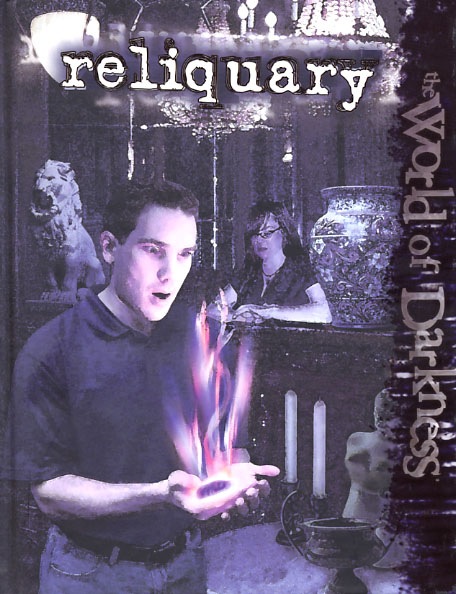
Wood: Reliquary is out there now, and it's a book
about how to storytell mystical artifacts - and also how to create them. You
can create your own, place them, and tell stories about them. The book gives
you concrete tools to do it, too.
Justin Achilli, Matt
McFarland and the others produced some fine work.
Jess Hartley (interview coming soon), who
developed it, is rightly proud of what she led.

Wood: Well, in Requiem for Rome, you discover that
some of things you thought about vampire history were completely wrong, and something’s
are only slightly wrong. You meet familiar clans and bloodlines, and unfamiliar
ones.
The Camarilla has
four wings, and each has its own advantages.
And in the place of
the Ventrue are the Gens Julii.
In the book, you get
a full overview of Rome and what it's like for a vampire, people you might
meet, and things that might happen. It's full of guidelines for telling stories
from the founding of Rome to its fall...
...and in Fall of
the Camarilla, you get a fully-realised chronicle taking you across the fourth
century CE and its outcome.
 Want to drive in a
midnight chariot race?
Want to drive in a
midnight chariot race?
Want to hold a
banquet of the dead and leave to vomit the Vitae so you can feed some more?
Oh - did I mention
the social combat rules?
Adam: No please do!
Wood: Well, the Roman society of the dead revolves
around discussion, around debate, and the stakes often get ridiculously high. You
can lose all status, or even your (un)life if you lose a debate. The mechanics
kind of reflect this. Ray Fawkes did a fine job of getting them together. David
Chart had a hand, too.
Adam: could these rules be used for modern day
chronicles?
Wood: Yes. I've play tested them with three groups
now, and they've all loved them.
Wood: Right. One more question.
Adam: Is there anything that you can give us that is
not already available on the forums?
Wood: Hmmm. You get to meet the founders of not one
but two bloodlines still active in the modern day.
AND...
You'll discover the
nature of the Nemeses, the thing that vampires fear.
Adam: Wow. I think you’ve given us plenty us to drool
over. It has been much appreciated. Thank you.
A Dream of the Past 10 A short story by Poul Matras
The third article from the Dark Whipers, series A short Vampire story by Paul Matra
 If it had not been for the familiar faces in his dreams, he probably would have
felt alone, the cell was dark and dank. A smell of rot and carrion lay heavy in
the air, but of course that was to be expected from a torture chamber under a
graveyard.
If it had not been for the familiar faces in his dreams, he probably would have
felt alone, the cell was dark and dank. A smell of rot and carrion lay heavy in
the air, but of course that was to be expected from a torture chamber under a
graveyard.Anthony had recognised the place the first time he set foot there, he had seen it more than once in his dreams and he had even been able to distinguish which cell he would be held in, and almost precisely when his sleep would be disturbed by his holders.
This place had been explicitly vivid in his dreams, he had not just seen it, he had stood there in the cell and felt the damp air and the horrible smell of the graves above. He had touched some of the bloody knives and manacles and felt the cold merciless steel of which they were crafted. He knew that when his visions were this vivid they were important, the things they potrayed were crucial for the fate that was intended for him.
He had always known that someone planned his fate, he had been led through his entire life by a dark hand with an unscrupulous sense of humour and a plan incomprehendible for the mortal mind. And now it had led him to this cell, where he knew his life would take a turn for the darker... Darker than ever before.
This night he did not dream of the present or the future as he usually did, he dreamt of the past, his own past. That had never happened before, and in the dream he was surprised, for he was used to seeing places his waking eye would later recognize and living people whom he had never met before, yet he knew they were real.
But tonight he saw his mother screaming as she gave birth to a child. A darkhaired browneyed child, with none of her husbands features. He saw how the child as three years old witnessed his father screaming that his mother was a whore and a liar. He saw how he struck her when she objected and he saw the father leave.
"So my father died in the war?" He thought and sighed in his sleep.
The vision jumped forward in time and showed his school, the classroom filled with children busy in their chatter not sparing him a second glance. The teacher never recalled his name and he never felt welcome in class, so his vision shifted to his place of happiness in this sad and solitary time: the library. He followed his own evolution from a six year old to a ten years old, he saw the bruises gained whenever he showed his head outside the library, he saw how other kids found it funny to tackle him if he did not make his way through the school yard fast enough, and he saw how he never felt welcome anywhere but in the library, even at home his mothers stressed disposition made him long for his books.
And then he saw the fire. The fire that scorched the library, destroyed his books, and filled his lungs with a thick black smoke making him sick for weeks thereafter, he still had a nasty cough as a result.
The visions grew dark with smoke, and when the thick black layer lifted, he saw the twelve years old Anthony practicing gymnastics in the break, in stead of playing with the other children, he saw his skill grow and he saw the joy of the accomplishment in the child’s eyes. And then he saw the same child limping home not able to walk probably due to the damage to his leg. He remembered vaguely the fat boy who had jumped on it while he was lying on the cement of the schoolyard, pushed over by one of the bullies.
He saw a woman barely recognizable, in two years his mother had grown ten years older, with the strain of her work and the stress of her dark thought of how little chance her child had in this dark world. He saw how her heart broke when the same child limped into the room crying his brave tears.
The doctor who looked at the leg, was busy and hurried over the details, the young Anthony tried to remember everything he said, but it was to fast and the pain was great, so in the end he had to return two months after, having strained his leg. This time the message was clear; “you better avoid gymnastics in the future.” The child did not cry, he had known it would get worse; he had grown used to losing everything he loved.
Nothing was left to make the child in the vision happy, nothing but the worn out, sad and worried woman who was his mother. Anthony tried to close his eyes to block out what would happen next, but he knew already that this was not possible, he was forced to see the one person he had loved die. He watched in silent agony as the car hit her, and he did not get angry when the driver sped away. He contemplated the futility of his mothers last struggle to reach home before she passed out, and he pitied the boy who desperately struggled to remain calm enough to call an ambulance. He watched as the younger boy watched his mother die, both of them unable to change the cruel will of fate.
Once again time shifted forward and launched the sad and lonely boy into a new home in an orphanage. The room he slept in was cold and void of pleasure, his mind was forced to work only with what it could devise itself, for even though he shared the room with three other boys the younger Anthony was alone, in this cell he had been gifted by the pity of the world.
The boy grew, through years of solitude in the middle of a crowd. He learned the lessons of his schoolbooks and he slowly became more and more like the Anthony who was silently watching him. The boy had always dreamed, but in these years I grew in intensity and regularity, and soon the boy seemed to recognize every face, which drifted by him in his pitiful existence.
The vision finally reached the night, where Anthony had drifted on the streets not wanting to return to his prison, and by the hand of fate had been led past a graveyard he recognised. He knew who dwelled there, and he knew they would be attacked. The older antonym shook his head when his former self braved the graveyard gate and trod onto the once holy soil. A dark figure approached the now grown boy and spoke the sentence that had rung in so many of his visions: “coming here tonight will prove to be the most interesting mistake you have ever made.”
And so the boy was led by guards into the darkness under the graveyard and down till the cell. It was a cell which would inspire fear in any mortal, it was a cell that had undoubtedly taken many a life, but at least it was a cell of his own.
And now as his dream had caught up with him, Anthony saw a figure he knew and cherished, a figure that had been in the dreams he both feared and loved, the person who would kill him.
Anthony saw him scaling the steps downwards, passing through the hallways and entering the prison and Anthony’s cell.
He was not sure if he was awake or still dreaming when the man caressed his chin, nor when he whispered strange words in his ears. But he anticipated the final act, he longed for this moment of decision where fate would finally give him the last crippling blow and rob him of the world he had come to loath.
Only when the long, pointed fangs sank into his neck did he realise the trick fate had played upon him: the man who would bring him the gift of death was also to bring him its curse.
Anthony died with the unbearable knowledge that he would go from being the one whom fate tormented to being yet another of fates instruments of torture.
Interview with Peter Mohrbacher
In the second Dark Whispers Instatement,
an interview with the artist Pete Mohrbache. who's work you will have seen
in Changeling: Source, Changeling: Fall, Changeling: Spring, Changeling:
Summer, Scion: God, Scion: Demigod, Exalted: Scroll of
Kings and Vampire: Rome. You can see his work here http://one-vox.deviantart.com/
Adam: So to get started would you
introduce yourself and give a little personal background?
Pete: My name's Pete Mohrbacher but
I also go by Bugmeyer or One-Vox on the internet. I'm 24 and I have been
working as a freelance artist for about 2 years now. I like long walks on the
beaches and fine foods.
Adam: How long have you been an artist?
Pete: I started drawing back in 2000
while I was still in High School. Most people tell me that's pretty late
considering most people say they've been doing it since birth. Not sure if that
makes me fashionably late or just tardy.
Adam: Have you had any formal training in the fine arts?
Adam: Have you had any formal training in the fine arts?
Pete: Not in fine arts per se. I
earned a bachelors degree in Game Art and Design with asperations of being a
game developer. But I taught myself to paint during my time in college. Turns
out the painting has gotten me farther then the degree. The whole experience of
being in a creative environment made a huge difference on my development, but
the education itself seemed to have a very minor effect on me.
Adam: What are your biggest artistic influences and inspirations?
Pete: I'm always being influenced by
different things and for different reasons. When I started drawing, it was
because I was into anime and my work was big googly eyes and pointy noses. Over
time I've cobbled together different bits of things I've seen from other
artists over the years. The stuff that has stuck with me the longest is fantasy
work with a horrific slant like Kuang Hong or Zdzislaw Beksinski. Its important
to me to channel as much of my own energy as possible, because I think its
really hard to get noticed if you look a lot like the people around you.
Adam: Can you describe your creative
process - how you come up with ideas for
a new drawing and how you take those ideas and create a finished piece
of art.
a new drawing and how you take those ideas and create a finished piece
of art.
Pete: I like to start with key words
or symbols. Well...the process truly starts off by drinking a ton of coffee,
but then I get to word association. It helps me to get the tone of the piece
right. One I start drawing I try to get the core ideas down in the sketch
before I start working. But after I've gotten something loose, I paint over the
whole mess in Photoshop using my 40 40 40 brush. That is a round size flow
brush 40px large, 40% opacity and 40% flow. When I need to get something
smoother I turn the opac down and when I need to work faster I turn the opac
up. I like to use texture overlays to add depth, but I tend to paint into them
a bit so they look more natural.
Adam: You do a lot of art within
pre-existing worlds. What sorts of challenges does that pose for you? How do
you work in your own unique touches and ideas, and are you given freedom to
expand on those said worlds?
Pete: I think a large part of that
balance is in the hands of the art director. They've got the challenging job of
hiring someone who is right for the job for the right pay at the right time.
Once you get roped into a project you just have to trust their judgement in
picking you. The only way to produce real quality work is to follow your own
inspirations, so trying to bend to some ethereal concept of how its
"supposed" to look is just going to produce garbage. You still have
to follow the style guide, so when a character has big ears you draw big ears
and when they are supposed to be jumping in the air you draw them jumping in
the air. But when it comes to everything else, you just have ignore all the
other artists and ignore what you think you know about the project and just
make something that you are truly into. An AD doesn't want to hire someone to
recreate the same stuff they already have, they are hiring someone who will
contribute something fresh and interesting to a project. Or at least, that is
my experience.
Adam: So was that your introduction to
the world of role-playing?
Pete: The first game I ever saw was the
old version of Changeling way back in the day before I was an artist. But I played
D&D and then Mage with a core gaming group for years. Unfortuantely, I
started getting jobs working on RPGs after I had already fallen away from
playing them. Though White Wolf's new releases are threatening to draw me back
into the fold.
Adam: What advise can you give to
someone who is starting, or thinking of getting into the art world?
Pete: Be totally obesssed with art
or just keep it as a hobby. This is one of the hardest industries to make a
living at. Trying to be a famous artist is about as easy as being a famous
actor. If you can't do anything else, go for it, but don't get into it
expecting it to be easy.
Adam: How did you come to work at White
Wolf?
Pete: They E-mailed me. Apparently one of
the art directors saw my Epilogue gallery and wanted to try me out. People ask
me this question all the time, and I'm fairly sure that the only way to get
hired by them is by reference or google search. But I have no idea really.
Those guys seem to go out of their way to avoid looking at people portfolios. I
don't blame them, you can only look through so many hundred awful portfolios
before you want to claw your own eyes out. When you are a name like White Wolf,
everyone and their little sister wants to show you their doodles.
Adam: What books have you worked on so
far?
Pete: I've worked on 4 of the 5
Changeling books, I missed the Winter book because I was out of the country at
the time. I've also done a couple of Scion books, an Exalted book and the roman
Vampire book. I've got plans to do more Changling and Vampire projects.
Adam: What is your favorite book you've
worked on so far? Which has been the most rewarding?
Pete: I had a really good time with the
Changeling: Autumn Nightmares. I love that project to pieces, I love the wealth
of information Aileen provides with the art notes and that is my favorite
court. But I have to say that I crack open that beutiful hardcover Changeling
source book every once in a while just because I like the way the whole thing
looks. I'm a big fan of the source material that whole project was based off
of, so I'm really proud to be a part of any iconic dark faerie
literature.
Adam: What can you tell us about your
current pieces?
Pete: I've been slowly updating my
iconic Angelarium series. After a few years, they all started to look a bit
dusty, so I have been progressively updating them to better represent my
current ability. However I have been too busy with contract work to do much of
it recently, so I am looking forward to easing up my schedule a bit to get back
to them.
Adam: Can you tell us anything about the
summer Changeling book
Pete: Honestly, I don't know much
about any of the books I work on. Despite having a large amount of source text
for them, I tend to focus in on the parts that I am a part of. Though, I have
gotten the sense that people are coming out of the woodwork to contribute to
this book. Seems like the word has gotten around about how much fun it is to
work on or people just like the series and want to be a part of it. The whole
flavor seems to be getting very popular thanks to authors like Neil Gaiman.
Adam: Is there anything that you can
give us that is not already available on the forums?
Pete: There are forums? I'm kinda
removed from the whole culture...
Adam: It has been much appreciated.
Thank you.
Pete: No prob.
Background Development 101 by Ryan Davidon
This was the first article that was written by Ryan for the Dark Whispers Magazine. Thanks again for all the hard work that was put in.
Background Development 101
Some players have difficulty finding
significant ways to relate the dots they’ve placed on a character sheet to the
character concept they have created. In
this article, I will attempt to pin down a method of approaching a character
sheet from the top down, using the information on your sheet to fuel ideas
about the person behind the numbers. As
a case study, I will evaluate the character sheet of a non-supernatural
character. I’m going to call him “Ben.”

Concept
At the top of your character sheet, along
with the core pieces of information such as the character name, your name, the
chronicle, and so on, you are provided with space to give a short description
of your character in the form of a concept.
This piece of information forms the core of your character. It works as a sort of archetype, the mold
from which your character will be cast.
Ben’s player has thought about the sort of
character he would like to play, and thus far he keeps coming back to “scruffy
drifter.” So, not knowing more about his
character, he pencils this into the Concept area at the top of his sheet. He also writes this a spare piece of paper he
is using to develop his background.
The concept you write down is not set in
stone. Remember that you can always
revise that concept, or even violate it with your skill selection to a certain
degree. Differ too much and the concept
doesn’t really fit any more, so you need to be careful, but a two word
description of your character doesn’t paint enough of a picture to say what is
and what isn’t valid to put down on the sheet.
Virtue and Vice
Using the concept as a springboard, decide
how your character tends to pursue his or her virtue and vice. A short paragraph each tends to be the most
rewarding amount of information. You
don’t want to overburden yourself with background at this stage.
 Ben’s player looks at his chosen virtue:
Charity. He writes “Ben has been roaming
the highways and byways of the US for a few years now, and he’s come to believe
that it’s best to share a little with the needy, because you never know when
you’re going to find yourself out in the cold in need of a little help
yourself.”
Ben’s player looks at his chosen virtue:
Charity. He writes “Ben has been roaming
the highways and byways of the US for a few years now, and he’s come to believe
that it’s best to share a little with the needy, because you never know when
you’re going to find yourself out in the cold in need of a little help
yourself.”
Ben’s player then moves on to his vice:
Sloth. He writes “Life on the road is
hard, and sometimes it can be easier to give up than get what you want. Ben has problems keeping himself motivated to
move on with his goals. He also finds it
easier to pick a new goal than to complete a difficult one.”
Sometimes the presentation of a virtue or
vice in a character’s personality is not standard. Consider a character in whom Wrath manifests
as a desire to spread nasty gossip about people who slight her, or a character
that has Prudence, but takes it to the extreme of a crippling fear of taking
risks (this concept may work better for an NPC than a PC, unless your game
allows much more room for social interaction than combat and danger).
Attributes
 In allocating your attribute dots, you’ve
probably decided to model them in a way that directly supports the concept of
your character; your martial artist has primary physical attributes and a three
in Strength and Stamina; your computer scientist has a four intelligence and a
one composure; your flippant debutante has four dots in Presence, three in
Manipulation, but only one in Composure.
In allocating your attribute dots, you’ve
probably decided to model them in a way that directly supports the concept of
your character; your martial artist has primary physical attributes and a three
in Strength and Stamina; your computer scientist has a four intelligence and a
one composure; your flippant debutante has four dots in Presence, three in
Manipulation, but only one in Composure.
At this point, you can take a moment to
explain just how the character’s background molded their attributes. The debutante’s high Presence might be the
result of being the captain of her speech and debate team as well as a member
of the model UN. Her manipulation could
come from snaring daddy into getting her way.
Simply choose those defining attributes that are remarkable—either good
or bad—and use them to help define who your character grew up to be.
Ben’s player gave him the scores you see to
the <SIDE>. He explains “Ben never
finished high school, and he isn’t too bright.
But he’s been wandering for a long while, and he learned to be
tough. He never gives in to the
elements, and he’s really good at keeping his cool. Being a drifter, he’s also spent a lot of
time learning to convince people to part with things that he needs more than
they do.” As you can see, this tidily
explains all of Ben’s attributes that aren’t just 2 dots.
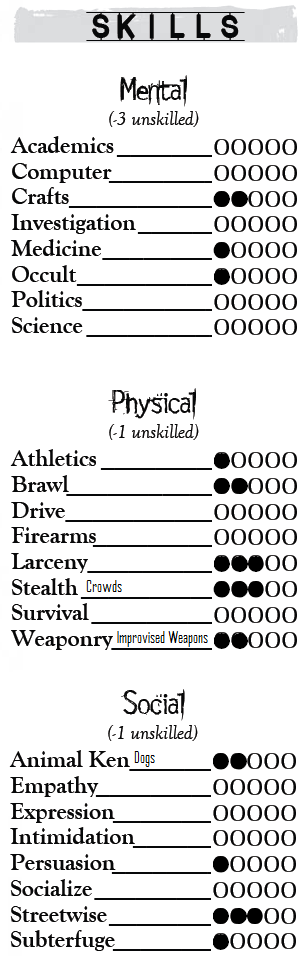 Skills
Skills are the largest portion of a
character’s background. They really tell
you what he or she is good at, and all you need to do is decide why the
character has the dot arrangement he or she does. Many one dot skills can stand without
explanation, especially when they have a clear tie-in to the character’s
concept. But for most skills of two dots
or more, it’s a good idea to explain why the character has that skill, how he
or she acquired it, and how he or she uses it most often.
After giving this section a lot of thought,
Ben’s player writes “Working sporadically, Ben tends to get odd jobs fixing
things like cars and other machinery.
However, he never works too hard; just hard enough to get by.
“In his travels, Ben has had to fight off
various vagrants and drug addicts. He’s
learned to fist fight and to fight with improvised weapons such as pipes and
loose bricks. As often as possible, he
just avoids the parts of town where he might ruffle feathers, so he listens to
the word on the street and thinks hard about how not to be there. He also knows when someone is about to get
the drop on him.
“Inevitably, Ben has been in trouble with
the law, and he can’t help but cause problems sometimes, even when he’s just
trying to help someone. He blends in
with the crowd easily, and knows how to keep his head down and stay out of
sight. When necessary, he has broken
into abandoned houses and once in a while he has stolen a car or two, but he
still thinks of himself as a pretty good guy who just lives a hard life.
Notice that this fails to cover Ben’s skill
in Animal Ken and specialty in dogs.
This will be covered in a moment.
Merits
The final relevant segment of the character
sheet to our purposes are the Merits.
Merits are naturally a catch-all, so they deserve special explanation. Merits can often be thought of as the result
of a character’s past experience. A high
school track runner might gain Fleet of Foot and use it again later in
life. A local musician might gain Barfly
from playing a lot of shows in town and meeting all the staff.
This definition doesn’t always fit, and
occasionally, a Merit just defies description—such as Unseen Sense. That’s okay.
Not everything needs to have a greater explanation.
 Ben’s player comes to the Merits section,
and he knows exactly how to start it.
“Ben’s best friend is his dog Howler.
Ben found Howler a few years back as a puppy and couldn’t bear to see
the little guy suffer. So he kept him,
and the dog has been his constant companion ever since. Keeping himself and his dog fed is a
challenge, but Ben manages.
Ben’s player comes to the Merits section,
and he knows exactly how to start it.
“Ben’s best friend is his dog Howler.
Ben found Howler a few years back as a puppy and couldn’t bear to see
the little guy suffer. So he kept him,
and the dog has been his constant companion ever since. Keeping himself and his dog fed is a
challenge, but Ben manages.
“Ben’s diet has often been poor. He’s had to grit his teeth and suck down
garbage from restaurant dumpsters to survive.
But the upshot is that Ben can choke down almost anything with no ill
effects. He’s got a cast iron stomach.”
Note that Ben’s player has chosen not to
explain his Fleet of Foot Merit, and Danger Sense has already been mentioned
briefly amongst his skills. This
cross-pollination of descriptions makes
more sense than trying to keep everything totally distinct. After all, a person’s life is rarely that
easy to pigeon-hole.
Equipment
Chances are if you’ve put a piece of
equipment on your character sheet, it is of some significance to your
character. Where did he get that gun or
that sword? Why does she have a toolbox
in her truck?
Describing equipment your character keeps
can also help you fill in detail about who he or she is and what is important
in his or her life. Anything that gives
an equipment bonus is probably worthy of some mention here. And don’t be afraid of being verbose. At times, even if your Storyteller and the
other players can’t remember everything you’ve said about your character, you
can refer to your background information to help you stay in character and
decide how to react to things.
Flavor
 In addition to giving general background,
it can be fun to sprinkle anecdotes from your character’s point of view into
your explanation of the background. A
one paragraph story about how your character came to own a specific item, or
her own words when complaining about how hard it was to write her research
thesis. Anything goes in creating
character background. A
graphically-minded player might even create a set of vignette images showing
the character’s life in stages, with a sketch of each significant event.
In addition to giving general background,
it can be fun to sprinkle anecdotes from your character’s point of view into
your explanation of the background. A
one paragraph story about how your character came to own a specific item, or
her own words when complaining about how hard it was to write her research
thesis. Anything goes in creating
character background. A
graphically-minded player might even create a set of vignette images showing
the character’s life in stages, with a sketch of each significant event.
All in all, it is just important to
remember that the dots you assign to your character are a skeleton, and the
flesh you give him comes from the background you create. You can even start to discover that your
character has interests that differ from your own, just by pondering what led
to certain skills or merits.
Subscribe to:
Posts (Atom)